
Scalloptic Protective Case for Fiber Optic Cables
Sealed protection for pre-spliced fiber in harsh environments

Traditionally, fiber optic cables carry long-distance telecommunications and high-speed data. In recent years, fiber optic cables are being used for a growing range of distributed fiber optic sensing (DFOS) applications. For the fiber optic cables to turn into DFOS sensors, the delicate glass fibers must be carefully fusion spliced with connectors, leaving a critical portion of the sensing array vulnerable. During gaps between data collections, fragile spliced ends might sit exposed, be buried or placed inside a ridged box with many fasteners, or wrapped in temporary containers with tape. When returning to the site, any degraded or broken ends must be re-spliced, which is costly, time consuming, and difficult to perform on-site in extreme, dusty, or cold environments.
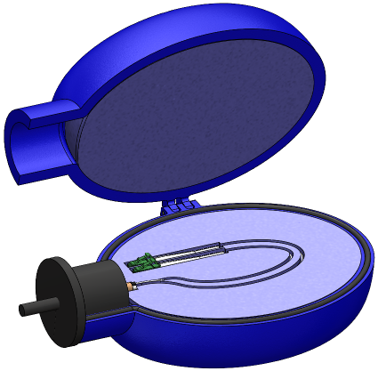
The Scalloptic protective device reengineers how spliced fiber ends are safeguarded. A non-metallic, water-resistant, insulated case with a hard exterior shell and a soft interior foam cushion forms a sealed enclosure around spliced cable ends. The compact, scallop-shaped housing prevents water and sediment exposure and protects against frost, creating a durable enclosure that can be buried between data collections. When the cable is needed, the housing is unsealed to expose the ends. When work is complete, the case is resealed to protect the spliced ends until the next data collection. Connectors can be fused to cables in an ideal setting, such as a laboratory, then shipped to the field without needing to be re-fused on arrival. Further, unlike existing ridged box solutions that require multiple screws, washers, bolts, and fasteners, the Scalloptic encasement can be easily manipulated by one person and its compression, water-tight design reduces the requirement of multiple complicated metal fasteners. Scalloptic protects the deployment team’s initial time and materials investment in a discreet, non-metallic case while significantly reducing the likelihood of repeated onsite resplicing, streamlining future DFOS testing.
Benefits:
- Sealed: Water-resistant, insulated enclosure blocks water, sediment, and frost
- Reusable: Reseals around the same cable ends for repeated use
- Field-ready: Connectors can be fused to cables in a lab, then shipped
- Durable: Hard outer shell and foam cushion can be buried when not in use
- Non-metallic: All materials are non-conductive
Applications:
- Long-distance telecommunications
- High-speed data transmission
- Civil infrastructure monitoring
- Distributed acoustic sensing
- Distributed temperature sensing
- Distributed strain sensing
- Distributed fiber optic sensing
- Academic and field research
Patents
- 18/900,810 (Copy & search patent)