
Computer-Aided System for Airborne Contaminant
New system provides rapid calculation to improve airflow

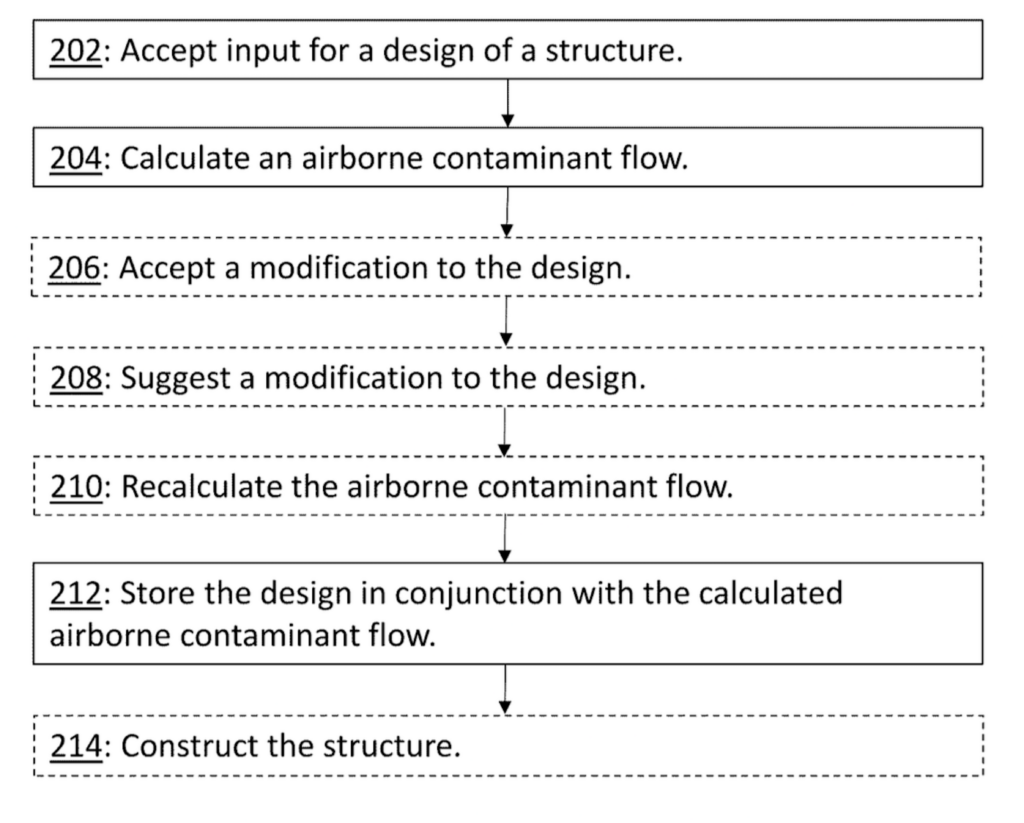
This computer-aided design (CAD) system is intended to provide rapid calculation of how airborne contaminants would flow within a building, based on the building’s design.
This system is designed to provide data applicable to pathogens, allergens, bioterrorism agents, volatile organic compounds and other airborne contaminants. It uses a closed-form mathematical solution applied to multi-zone/network-based airflow modeling for assessing airflow impacts, vastly decreasing the time and expense needed for this calculation. Such calculations can be integrated throughout the design process in near real-time, allowing designers to see the impact of different architectural choices and prompting them to consider airflow when designing and modifying buildings. The data also helps designers specify heating, ventilation, and air conditioning (HVAC) systems to actual building needs and in compliance with applicable code, eliminating the incentive to over-specify HVAC systems for worst-case scenarios. The CAD system includes a suggestion module that provides recommendations, which designers may accept or decline. As an additional embodiment, the technology can be paired with an existing smart HVAC system to enable real-time response to airborne contaminants, minimizing harm to building occupants.
While access to safe indoor air is critical, current systems for calculating airflow within buildings are costly and time-consuming, limiting designers’ options for understanding the impact of architectural choices on airborne contaminant flow. As a result, designers often use such models only at key decision points or after finalizing plans, rather than leveraging them to optimize airflow. This can lead to missed opportunities to support human health and to over-specification of HVAC systems, needlessly increasing building and maintenance costs.
Intelligent HVAC System Airborne Contaminant-Flow Calculator
In a related patent, US10907847B2, an HVAC system incorporates the airborne contaminant-flow calculator described above, extending the same closed-form contaminant-flow engine into a real-time control embodiment. This intelligent HVAC system can react to the introduction of a contaminant (such as airborne radioactive particulates, smoke, bioterrorism agents, or pollen) to recalculate the building’s airflow in a way that protects building occupants. For example, the system may close a shutter in the air ducts, turn up a fan, or redirect airflow to a standby filtration system.
Benefits:
- Faster: Provides airflow data in near real-time
- Cost-saving: Saves design time; reduces building and maintenance costs
- Integrated: Prompts designers to integrate airflow considerations into process
- Empowering: Provides data to support real-time decisions
- Supports code compliance: Helps designers meet codes and safety standards
Applications:
- Military and government buildings
- Healthcare and long-term care facilities
- Schools, transit hubs, and other high-use public spaces
- Office buildings
- Multi-unit residences
- Emergency preparedness and response planning
Patents
- 18/373,215 (Copy & search patent)
- 16/147,063 (Copy & search patent)